Led by WHGI, The Challenge Initiative (TCI) has released what it describes as the first at-scale look at how the 2025 U.S. foreign aid cuts have affected family planning - built not on statistical models, but on the actual health records that local governments keep.
The new bulletin, "Holding the Line," analyzes monthly facility-level data from 214 TCI-supported locations in 13 countries across Africa and Asia. Its central finding: growth in the number of women using modern contraception has slowed by more than half. In January 2025, these locations were adding roughly 1.86 million new users a year. By June 2026, that pace had fallen to 844,000 a year.
The dismantling of the U.S. Agency for International Development (USAID) in early 2025 did more than cut funding. It also interrupted the U.S.-backed survey systems that would normally be used to measure the consequences. In TCI-supported locations, however, government-run health information systems never stopped reporting. That continuity has given researchers an uncommon, real-time window into the crisis as it unfolds.
What the data show
- The number of locations losing family planning users has more than doubled, from 36 when the cuts began to 77 today. Almost two-thirds of them are concentrated in four countries: Kenya, Tanzania, Uganda and Senegal.
- Combined, those 77 locations are losing an estimated 400,000 users a year, in areas home to 22.9 million women of reproductive age.
- Another 73 locations are still growing, but at less than half their earlier rate. Where they once added about 900,000 users a year, they now add around 400,000 - close to half a million additional users forgone every year.
- Not every location has lost ground. In Nigeria and Cote d'Ivoire, growth has actually accelerated since the cuts began, a sign that government-owned, locally led programs can absorb a sudden loss of outside funding.
- Separately, an independent 2026 evaluation by Itad credited TCI's coaching model with meaningful gains in contraceptive use and found a positive return on investment in every geography it studied.
Kojo Lokko, TCI's Executive Director, explained why the program is positioned to see these effects so clearly: "Because TCI strengthens both health systems and staff capacity at the subnational level, we have a front-row seat to the real-world impact of these massive funding cuts on communities."
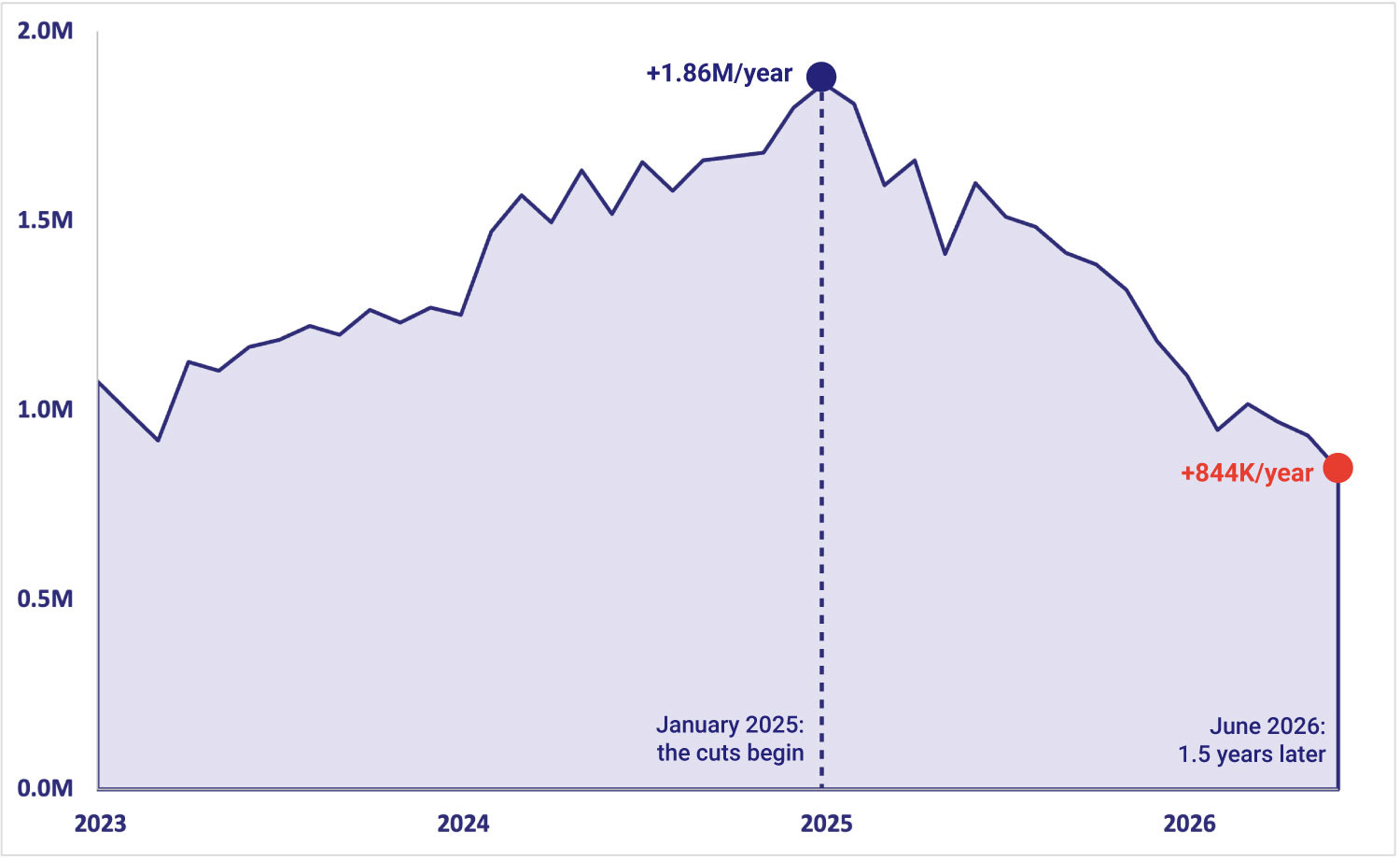
Users added over the trailing 12 months, all 214 locations, January 2023 to June 2026 (government HMIS, unsmoothed).
A focused call to action
Rather than asking for everything that was lost to be rebuilt, TCI is proposing a targeted, time-limited response. It is urging donors and development finance institutions to fund a re-ignition and re-engagement push in the locations now losing users, with progress that can be verified month by month in the same government data behind the bulletin. National and local governments are encouraged to protect their family planning budget lines and hold on to the resources they fought for before the cuts. Implementing partners, meanwhile, are invited to draw on TCI's coaching model, diagnostic tools and other resources, all of which are open for replication.
For WHGI, these findings speak directly to why locally led programming matters. TCI coaches city and local governments to run their own family planning and maternal, newborn and child health programs with their own staff and budgets - an approach rooted in the Institute's commitment to expanding reproductive health access, strengthening local health systems and building evidence-based programs that last. The resilience seen in Nigeria and Cote d'Ivoire, along with the ability to track this crisis in real time through government-owned data, shows what sustained investment in local ownership can deliver. A targeted re-engagement now could help protect hard-won gains for millions of women.
Read the full "Holding the Line" bullet along with an infographic of key findings on TCI's website.