WHGI Research Area
Demographic Futures and Population Dynamics
Investigating how population change is reshaping economies, health systems, labor markets, and societies.
WHGI’s Demographic Futures work helps decision-makers understand how population change is reshaping economies, health systems, labor markets, and societies in different ways across the world.
What We Study
WHGI’s Demographic Futures work helps decision-makers understand how population change is reshaping economies, health systems, labor markets, and societies in different ways across the world.
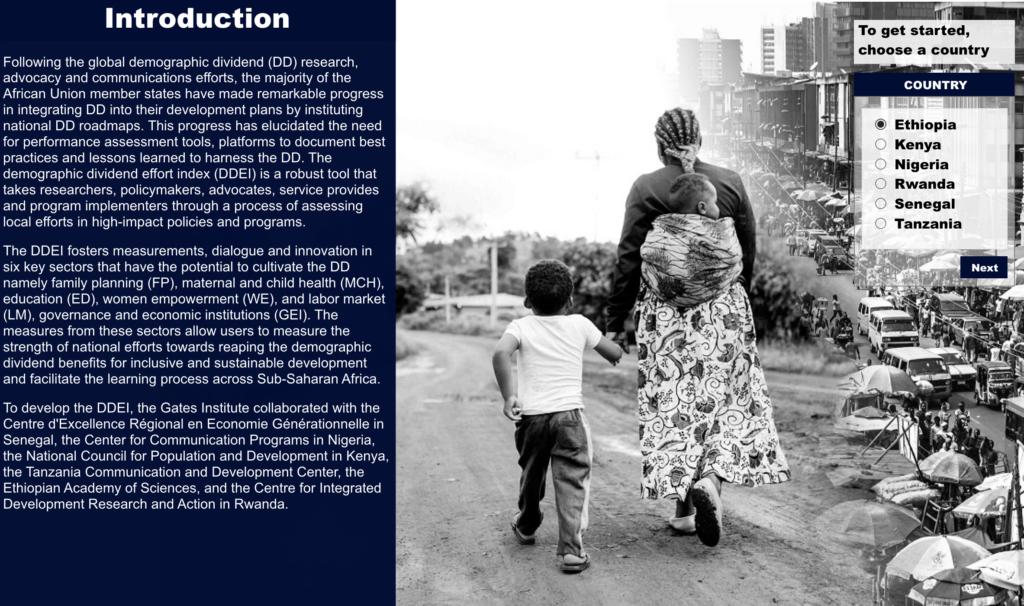
A major focus of our work is supporting countries with young and growing populations to understand how demographic change can contribute to their development goals. Through the Demographic Dividend Effort Index (DDEI), we assess the policies and programs countries have put in place to create the conditions for a demographic dividend—the potential for accelerated economic growth that can arise when fertility declines and the share of the working-age population increases, alongside sustained investments in health, education, employment, governance, and other enabling sectors.
The DDEI is implemented in partnership with National Population Councils and Commissions (NPCs), government institutions that coordinate population and development policies across sectors. WHGI has implemented this work with national partners in Uganda, Nigeria, Kenya, Rwanda, Tanzania, Ethiopia, Senegal, and the Philippines.
Why it Matters
There is no single demographic future. Global population is projected to peak at approximately 10.3 billion in the mid-2080s, but this global trajectory masks dramatically different realities. Some countries continue to have young and rapidly growing populations, while others are aging rapidly and facing shrinking workforces. In Latin America and the Caribbean, for example, the population over age 60 is projected to double in only 28 years—a demographic transition that took more than 60 years in Europe.
These differences matter because demographic change shapes opportunities and constraints across virtually every area of development. Countries with large young populations may have an opportunity to accelerate economic growth through the Demographic Dividend, but only when changes in population age structure are accompanied by investments in health, education, gender equality, employment, and governance. Countries experiencing rapid aging face a different set of questions about labor supply, health and long-term care, social protection, and economic productivity.
Traditional demographic data remain essential, but decision-makers increasingly need more than snapshots of the past and present or population projections alone. They need tools that show how demographic change may interact with climate shocks, labor-market disruptions, health-system pressures, technological change, and other emerging challenges. Demographic Intelligence can help translate these complex interactions into evidence that governments can use to anticipate needs, target resources, and assess the potential consequences of policy choices.
What Comes Next
Looking ahead, WHGI is building on its Demographic Dividend work to advance a broader Demographic Intelligence agenda. One direction focuses on strengthening and expanding existing tools to provide more granular and timely information. A second explores new analytical approaches, including synthetic populations and agent-based modeling, to help decision-makers anticipate how policies and external shocks may affect different population groups.
A third direction connects demographic change with broader development challenges, including climate change, population aging, labor markets, economic planning, and governance. Across these areas, WHGI aims to make demographic evidence more predictive and actionable—helping decision-makers not only understand demographic change, but better prepare for its implications.
Key Resources & Publications in This Area

Demographic Dividend Effort Index Dashboard
Demographic dividend-favorable policy environment in two pre-dividend African nations: review of national policies and prospects for policy amendments in Nigeria and Tanzania
Development of the Demographic Dividend Effort Index, a novel tool to measure existing efforts to create a favourable environment to harness a demographic dividend: results from an experts’ survey from six sub-Saharan African countries
Generating and capitalizing on the demographic dividend potential in sub-Saharan Africa: a conceptual framework from a systematic literature review
Meet the WHGI Research Team

Institute Director | Professor
Dr. Philip Anglewicz is Director of the William H. Gates Sr. Institute for Population and Reproductive Health and Principal Investigator of the Performance Monitoring for Action Project.
Institute Director | Professor
Dr. Philip Anglewicz is Director of the William H. Gates Sr. Institute for Population and Reproductive Health and Principal Investigator of the Performance Monitoring for Action Project.

Assistant Scientist
Carolina Cardona is a health economist focused on understanding demographic processes and their effect on economic development. She is particularly interested in the influence of women’s sexual and reproductive health decisions on women’s roles in society and how they shape demographic transitions.
Assistant Scientist
Carolina Cardona is a health economist focused on understanding demographic processes and their effect on economic development. She is particularly interested in the influence of women’s sexual and reproductive health decisions on women’s roles in society and how they shape demographic transitions.

Demographic Futures Lead
Dr. Apoorva Jadhav is a demographer and an expert in family planning and reproductive health with two decades of experience in evidence-based policy formulation.
Demographic Futures Lead
Dr. Apoorva Jadhav is a demographer and an expert in family planning and reproductive health with two decades of experience in evidence-based policy formulation.
By the Numbers
Countries
WHGI has implemented this work with national partners in eight countries across Africa and Asia: Uganda, Nigeria, Kenya, Rwanda, Tanzania, Ethiopia, Senegal, and the Philippines
of the world's population lives in countries where population size has peaked.
lives in countries where population is projected to continue growing through 2054.
News on Demographic Futures & Population Dynamics

Now Open: The Demographics & Planetary Health Story Prize
The Planetary Health Story Prize is open for 2026 journalism linking demographic change and planetary health. Two $500 awards. Submit by 9 October 2026.
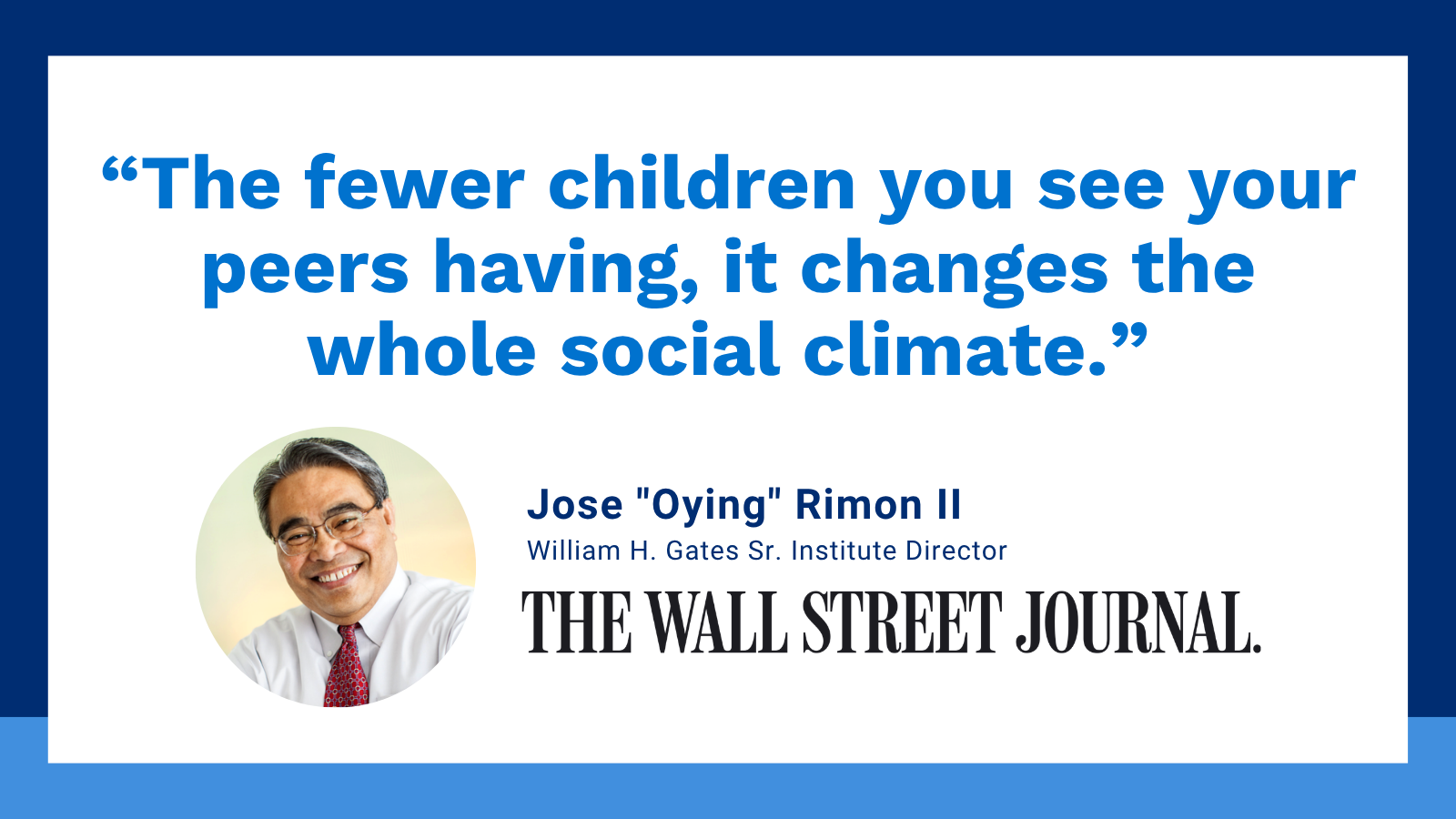
WHGI Director Jose “Oying” Rimon II Quoted on Falling Birthrates in New Wall Street Journal Article
Jose “Oying” Rimon, Director of the William H. Gates Sr. Institute for Population and Reproductive Health, was recently quoted in an article from the Wall Street Journal titled, “Suddenly There Aren’t Enough Babies. The Whole World Is Alarmed.” The article explores the social, economic, and geopolitical consequences of falling birthrates across countries.
William H. Gates Sr. Institute for Population and Reproductive Health Unveils Refreshed Strategy through 2030
William H. Gates Sr. Institute for Population and Reproductive Health proudly announces the launch of our 2023-2030 strategy. Through our participatory strategic refresh process, our vision has remained steadfast: a future where scholarship and science improve health and transform lives at scale.
Want to know more?
Connect with Us
Learn more about WHGI's Demographic Change & Population Dynamics work, access available data and publications, or connect with researchers to explore opportunities for collaboration. You can also visit the Demographic Dividend website.
Please send an email to gatesinstitute@jhu.edu with the subject line "Demographic Futures"