WHGI Platform
SMART Advocacy
A disciplined path from advocacy to outcomes.
What is SMART Advocacy?
SMART Advocacy (Specific, Measurable, Attainable, Relevant, and Time-bound Advocacy) is a practical, evidence-informed approach that helps advocates develop focused strategies to achieve policy and funding change. It provides a structured framework for identifying opportunities, engaging key decision-makers, building partnerships, and taking strategic action to advance advocacy goals.
Developed through the family planning advocacy community and refined through years of global experience, SMART Advocacy helps advocates move from broad priorities to clear, actionable strategies that create measurable results.
How Does SMART Advocacy Work?
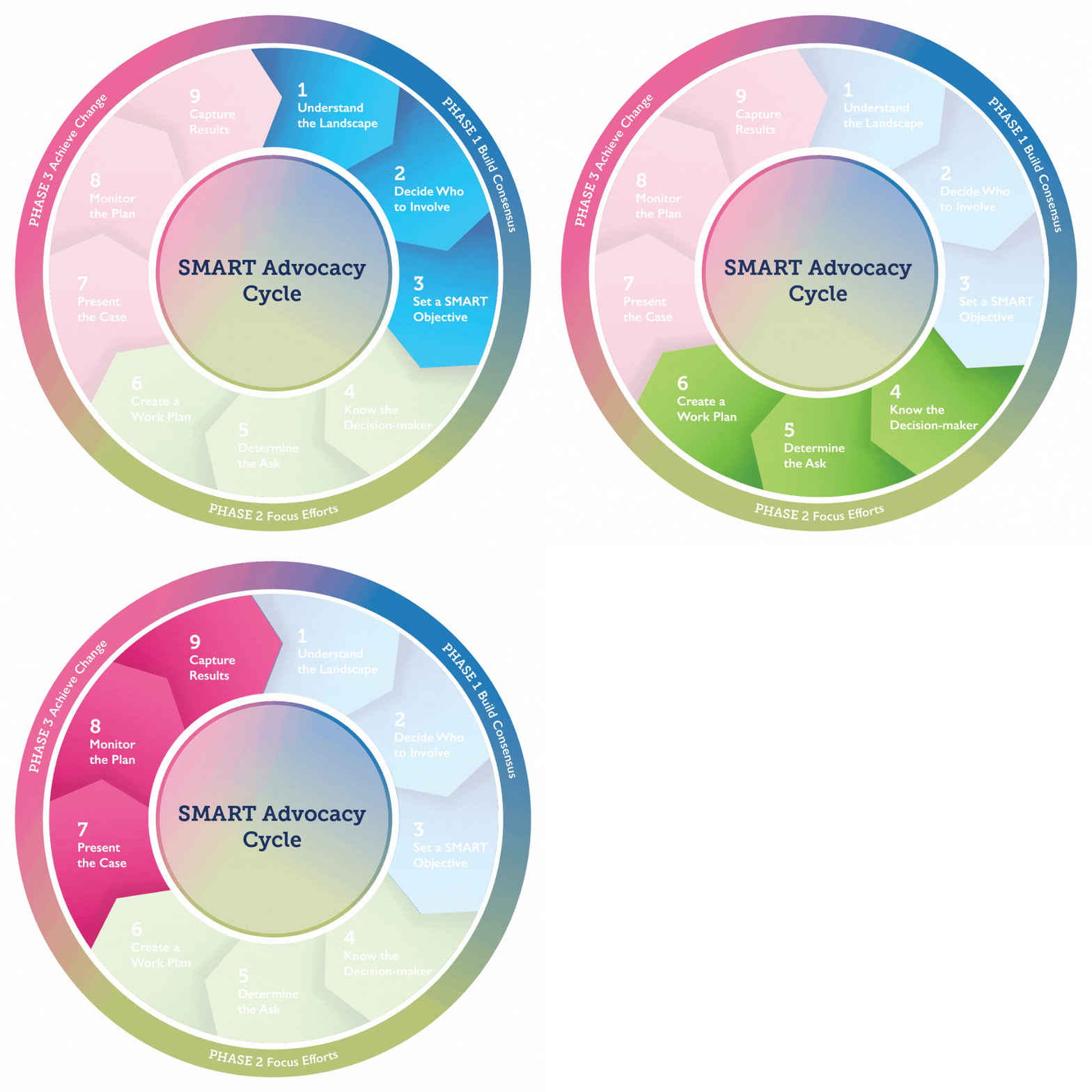
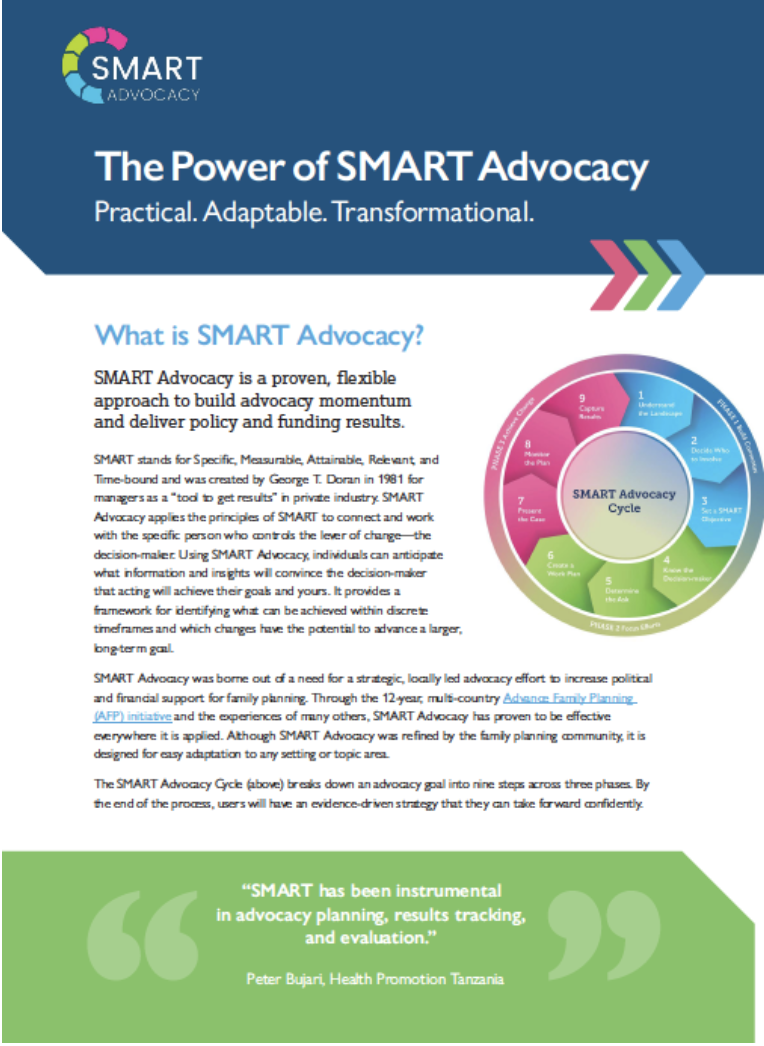
SMART Advocacy guides advocates through a three-phase process designed to help identify opportunities, focus efforts, and achieve results.
At the center of SMART Advocacy is a focus on decision-makers, the individuals and institutions with the authority to take action. By understanding their priorities, needs, and motivations, advocates can develop evidence-based strategies that align shared goals and create pathways for change.
What Makes SMART Advocacy Different?
SMART Advocacy combines strategic planning, evidence, and collaboration to help advocates create targeted approaches that lead to action. Unlike approaches focused primarily on raising awareness, SMART Advocacy helps advocates identify who has the power to make decisions and develop tailored strategies to influence those decisions.
While developed through the family planning advocacy community, SMART Advocacy is adaptable across countries, issues, and contexts. Its principles can be applied by organizations and coalitions working to advance health, equity, and development priorities.
What Impact Has SMART Advocacy Achieved?
SMART Advocacy has helped advocates around the world strengthen advocacy efforts, mobilize resources, and advance policy change. Through the Advance Family Planning initiative, SMART Advocacy contributed to more than $100 million in family planning funding commitments and hundreds of policy changes.
Organizations across countries have used SMART Advocacy to build advocacy capacity, strengthen partnerships, and influence decisions that expand access to essential health services.
What Resources are Available for SMART Advocacy?
The SMART Advocacy tools and resources below help advocates apply the approach in practice. Resources include advocacy planning tools, decision-maker analysis frameworks, training materials, and examples from advocates around the world.
These resources guide users through each stage of the advocacy process, from identifying goals and stakeholders to developing strategies, implementing activities, and measuring progress.
Why Choose SMART Advocacy
It's practical
Nine clear steps across three phases turn an ambition into an evidence-driven strategy you can act on with confidence.
It's adaptable
Refined in family planning, designed for anything. More than 250 organizations in 26+ countries apply it to issues of their own.
It's transformational
From first-timer to seasoned campaigner, SMART sharpens the work and has helped move over $100M and hundreds of policy wins.
The Proof
$100M
250+
26+
100s
A Phased Approach
Three phases, nine steps, with each one building momentum toward change.
1
Build consensus
Read the moment with evidence, map the actors and allies, and make the strategic choices that narrow your focus.
2
Focus efforts
Choose a key decision-maker, refine a precise advocacy ask, and design the activities that reach your objective.
3
Achieve change
Execute the strategy, assess and learn from every setback and success, and help others learn from your experience.
From Advocates on the Ground
“
The SMART approach has given us a totally new perspective in how to transform our advocacy initiatives.
Josephine Arnold
Tanzania Women Lawyers Association
“
I learnt how to influence key decision-makers and shift their thinking on gender-responsive budgets and disability rights.
Easter Achieng Okech
Kenya
“
An effective way to approach advocacy planning — it puts everything into perspective in a systematic manner.
Arun Nair
Foundation for Research in Health Systems, India
TOOLS TO HELP YOUR SMART ADVOCACY JOURNEY

These SMART Advocacy resources provide a compendium of best practices and tools to refine a strategic vision, identify and motivate key players, take action, manage and overcome setbacks, and monitor and evaluate success. Whether you are a new or experienced advocate, these resources can help you along the way to achieving your desired result: real, achievable, and sustainable change.
Used separately, the tools can supplement an existing effort or inject new life into an initiative that has lost its vision or momentum. Used together, they provide a comprehensive roadmap to develop, implement, and evaluate a focused advocacy strategy from start to finish.
USER’S GUIDE
USER WORKSHEET
FACILITATION POWERPOINT
The SMART Advocacy User’s Guide supports individuals through a 9-step process to develop an evidence-driven advocacy strategy. Intended for individuals, small groups, and larger coalitions, the guide provides customizable tools to help you plan concrete, specific actions tailored to your advocacy issue and environment.
The user worksheet templates enable you to build your advocacy strategy using the 9 steps. Answer the question prompts and fill in the boxes. Refer to the SMART Advocacy User’s Guide and/or the Facilitation PowerPoint for further guidance. The simple Word worksheets allow for easy adaptation to any setting.
Want to lead a group through the 9-step SMART Advocacy process? Use this Powerpoint slideset. It includes speaker’s notes and hidden slides with detailed instructions for facilitators to plan, execute, and evaluate their strategy sessions, both in-person and virtual. Make sure to adapt the slides with images relevant to your setting and issue.
Additional Resources
Related Posts

New WHGI Research Links Abortion Bans to Increases in Deaths During and After Pregnancy
New Resource: Abortion Bans and Public Health Policy Brief