It has been an eventful year for the William H. Gates Sr. Institute for Population and Reproductive Health (WHGI) and the broader family planning and sexual and reproductive health and rights (FP/RH/SRHR) community. The year 2025 began with major funding challenges as key donor governments reduced aid, heightening concerns about service disruptions at a time when hundreds of millions of women in low- and middle-income countries still face a high unmet need for contraception.
In response to this shifting landscape, WHGI hosted the Future of Family Planning Convening in March, bringing together more than 200 global leaders to strengthen evidence-based action, advance coordinated advocacy, and align priorities to accelerate progress in FP/RH/SRHR. The momentum and alignment generated in March helped shape our shared priorities for the year, laying important groundwork for the collaboration and advocacy that would later carry into ICFP.
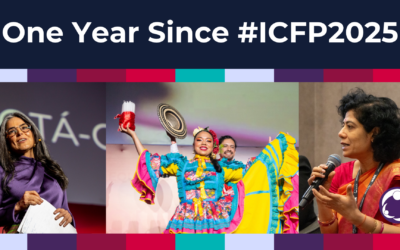
The community ended the year on a strong and positive note. It was an honor for WHGI to organize the 7th International Conference on Family Planning (ICFP), held in Bogotá, Colombia, from November 1–6, 2025. I want to take a moment to thank this extraordinary community and reflect on what we created together.
The highlights of the conference were too numerous to capture in a single summary, therefore we invite you to visit the ICFP 2025 Recap, which will be launched in March, to explore key sessions and outcomes in more detail. Still, several milestones stand out that drive home the importance of this event to our global community of over 50,000 strong.
First, the global FP/RH/SRHR community showed up— in force. Despite significant headwinds facing our field over the past year, ICFP exceeded expectations in every respect. More than 3,500 participants joined us for the 2025 ICFP. We received a record number of scientific abstract submissions—60% more than our previous high—along with record engagement from abstract reviewers and an unprecedented number of sponsors. These achievements are a testament to the resilience, commitment, and passion of this community. They also reaffirm a truth we know well: ICFP is more than a conference—it is a global platform, community, and movement grounded in partnership, inclusivity, innovation, and scientific rigor that builds momentum for SRHR year-round.
We were also incredibly fortunate to host the first ICFP in the Latin America and Caribbean region, with Bogotá serving as a powerful and fitting venue. Participants engaged deeply with the region’s rich history of FP/RH/SRHR leadership, sparking meaningful cross-cultural exchange. We were inspired by Colombia’s progressive and rights-affirming policies and by the government’s commitment to advancing equitable access to reproductive health care.
The conference theme, Equity Through Action, underscored our shared responsibility to dismantle persistent barriers to FP/RH/SRHR services worldwide. It reinforced a fundamental principle that unites us: everyone has the right to full reproductive freedom and to be treated with dignity and respect.
At the same time, we must be clear-eyed about the moment we are in. This is not an ordinary time for our field. Global support for FP/RH/SRHR has declined over the past year; USAID, the world’s largest multilateral supporter of family planning, has been dismantled; and anti-rights movements continue to gain momentum across regions, threatening hard-won progress. These shifts have profound implications for women, children, and families—the very people we serve.
Yet I am confident that we will not only meet these challenges, but emerge stronger. Change, while difficult, also brings opportunity. This moment calls for creativity, solidarity, and bold thinking as we forge a future that reflects today’s realities. Together, we can ensure that FP/RH/SRHR remain central to global health, development, and human rights—now and in the years to come.
Looking ahead to 2026 and beyond, WHGI remains committed to advancing a bold, multi-dimensional agenda rooted in science, partnership, and community. At a time when reproductive health and rights, women’s rights, and environmental progress face serious threats, we will stand firm through our interconnected global programs of demographic futures, research, policy & advocacy, next generation of leaders, gender equity, and best practices scale-up- which are designed to drive impact through 2030 and beyond.