By Natalie Apcar, Advocacy & Communications Manager
Debates about demographic change often focus on whether countries have too many people or too few births. But those headlines can obscure a different set of questions: Can people have the families they want? Are institutions preparing for longer lives? And are policies responding to evidence?
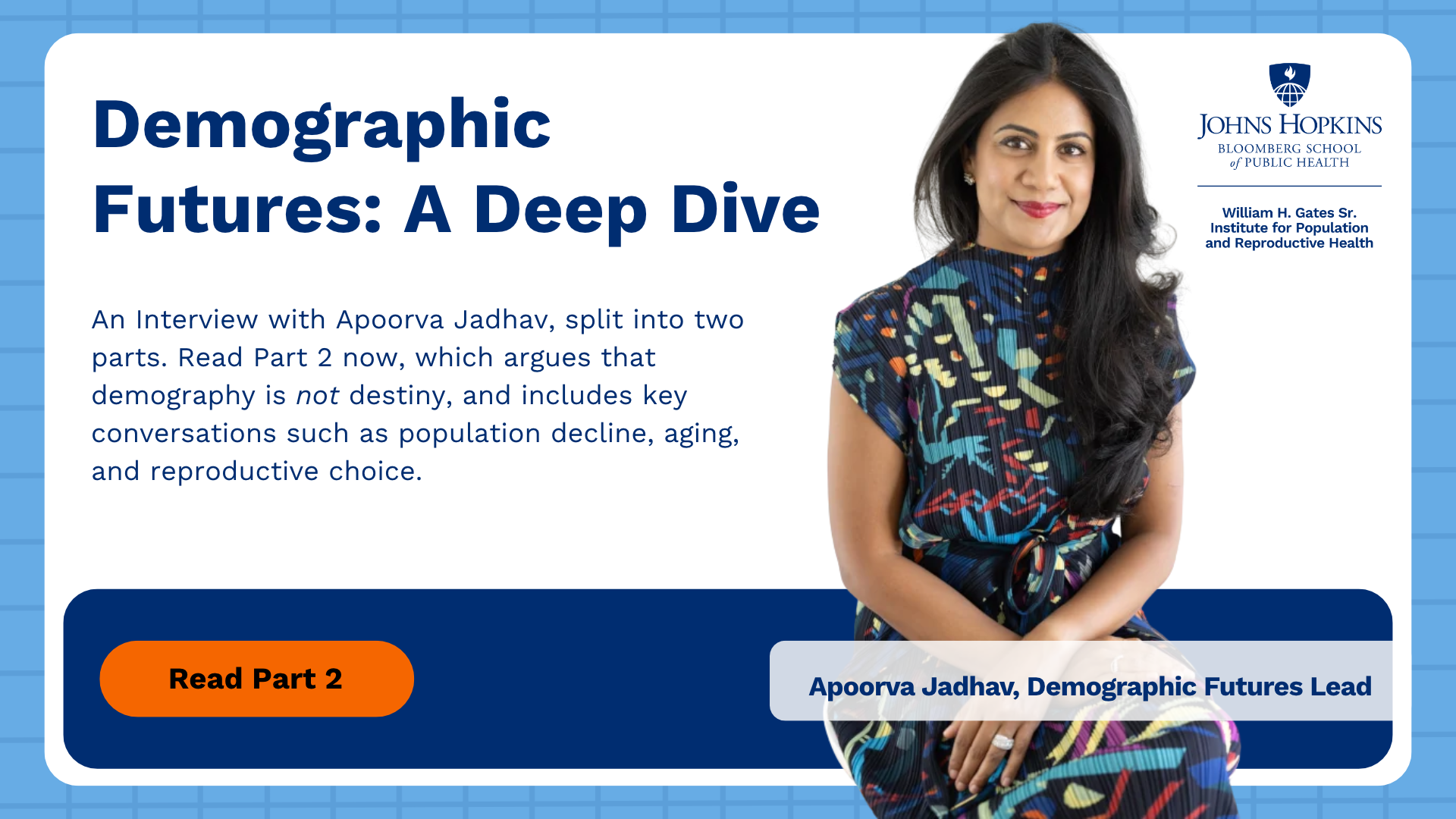
Following our introductory conversation about the demographic dividend, this interview with Apoorva Jadhav, Demographic Futures Lead at WHGI, and Senior Fellow at Population Reference Bureau and Non-Resident Scholar, South Asia Program, at Carnegie Endowment for International Peace, explores how governments can respond to changing populations while protecting reproductive choice. She challenges the idea that aging is simply a problem to solve—and argues for a closer look at the purpose and evidence behind population policies. Read on to explore this conversation.
If lower fertility contributes to population aging, why invest in family planning?
I think of a fertility decline as a public health triumph. It means that you have more infants and children that are surviving. You have women with reproductive agency. And here I would say that the dependency ratio doesn’t just vanish as the fertility level falls. It just changes the composition, shifting from children to elderly over time.
And so the dividend, I would say, is this time-limited window, to build the fiscal and institutional infrastructure that your aging population will need next.
If you are expanding access to good health care that includes contraceptive options. And if you do end up seeing, as demographic transition theory states, you’ll eventually see a fertility decline and it gives you time to also figure out what you will do when that age structure shifts.
I think population aging is also a privilege. That means that you’ve done something right. You’ve invested in the right things in order to get to a point where you have higher life expectancy.
I feel like in our world, we tend to pathologize everything. High fertility is a problem. Low fertility is a problem. Let’s take a step back and think about how demographic indicators can be a sign of public health triumphs.
Is there an ideal fertility rate?
It depends on the ideal for whom. I think that from a country’s perspective, it could be different from the perspective of a couple or something like that. But if you think about populations holding steady, 2.1 is roughly replacement level in countries with low mortality, because then you’re saying every generation basically replaces itself.

But I don’t think there should be any ideal, there shouldn’t be any targets, and the minute you attach a number to anything, it gets really slippery, particularly for women. But I think if you’re asking what demographic theory would say, replacement level is the rate at which, over the long run, a population neither grows nor shrinks. . And in practice, migration and population momentum mean a country’s population can keep growing or shrinking for decades regardless of where fertility sits, which is another reason a single target doesn’t make sense.
How is the demographic dividend different from population control?
When you think about population control, what do you think of? For me, I think of coercive family planning strategies. Coercion can take the form of efforts to control fertility in either direction, whether by restricting access to contraception or abortion to push births up or by pushing contraception or sterilization on people through targets, quotas, or incentives, without real choice.
The demographic dividend is this whole different beast, as I discussed in this blog post, which requires investing in your population’s health, education, jobs, all of these other things without any kind of coercive means in sight. So I think those are very different things. But I would say that some of the history of our field of demography has been plagued by population control.
What can countries learn from coercive population policies like China’s experience?
I think the lesson isn’t that fertility decline is bad because it causes population aging.. I think more that, if you force the decline to be faster than societies and institutions can adapt, yes, that’s a problem.
So you shouldn’t be forcing fertility to decline in any case. It’s not like population aging is the problem. I think that’s a better framing.
China is a really good example. It’s a cautionary tale even. China’s one-child policy, in place from 1980 to 2015, was layered on top of a fertility decline that was already well underway in the 1970s. Its legacy includes a heavily skewed sex ratio at birth, a population that is aging very quickly with a shrinking working-age base, and the ‘4-2-1’ family structure, where one child may support two parents and four grandparents. Now that China is trying to raise birth rates, it’s finding that reversing a decline is much harder than forcing one.
Are government incentives to increase birth rates effective?
When I think of pronatalism, I think of what is the definition? That means more births. Pro-family is different from pronatalist, see more here.
Cash incentives like baby bonuses tend to change the timing of births rather than the total number of children people have; where studies do find an effect on family size, it is small.
What does help are family-friendly policies, childcare subsidies, that sort of thing. But that doesn’t seem as exciting for any government to announce in a way.
Where incentives can do some good is when they’re tied to health. Like if it is incentivizing a person who was already going to have a child or is thinking about it, and they’re going to more visits for their like prenatal care or going to prenatal care, that’s healthy for the mother and the baby.
I think we also need to make sure that the choice to have a baby is a real choice that is the woman’s and her partner’s and not the state’s and not somebody else’s.
What do policymakers most often misunderstand about population dynamics?
 There is a tendency to simply read the headlines and not read research or the fine print anymore. And I think that translates to basing a lot of stuff on vibes and not evidence. I’d like us to go back to evidence.
I want policy makers to really pay attention to what is the evidence saying versus rhetoric. And it’s really hard in demography where every single thing that demographers work on, whether it’s migration, whether it’s fertility, they’re heavily politicized. And so a lot of times it’s not the demographers that are being asked their opinions.
And again, I think choice has to mean something rather than just being an abstraction. In contraception, we talk about a basket of choices: a range of methods, so people can pick what works for them. Reproductive choice more broadly should work the same way. People need real options, and the conditions to act on them, whether they want children or not.
Conclusion
Population change is often framed as a crisis: too many births, too few, too many older people. But falling fertility and longer lives are, in many ways, signs of success. The real test is whether governments use the time they have to invest in health, education, jobs, and institutions, and whether their policies expand people’s choices rather than narrow them. Demography is not destiny, but what countries do with it matters. That means grounding policy in evidence rather than headlines, and making sure the decision to have or not have a child stays with women and their partners, and the enabling environment to be able to act on those choices.