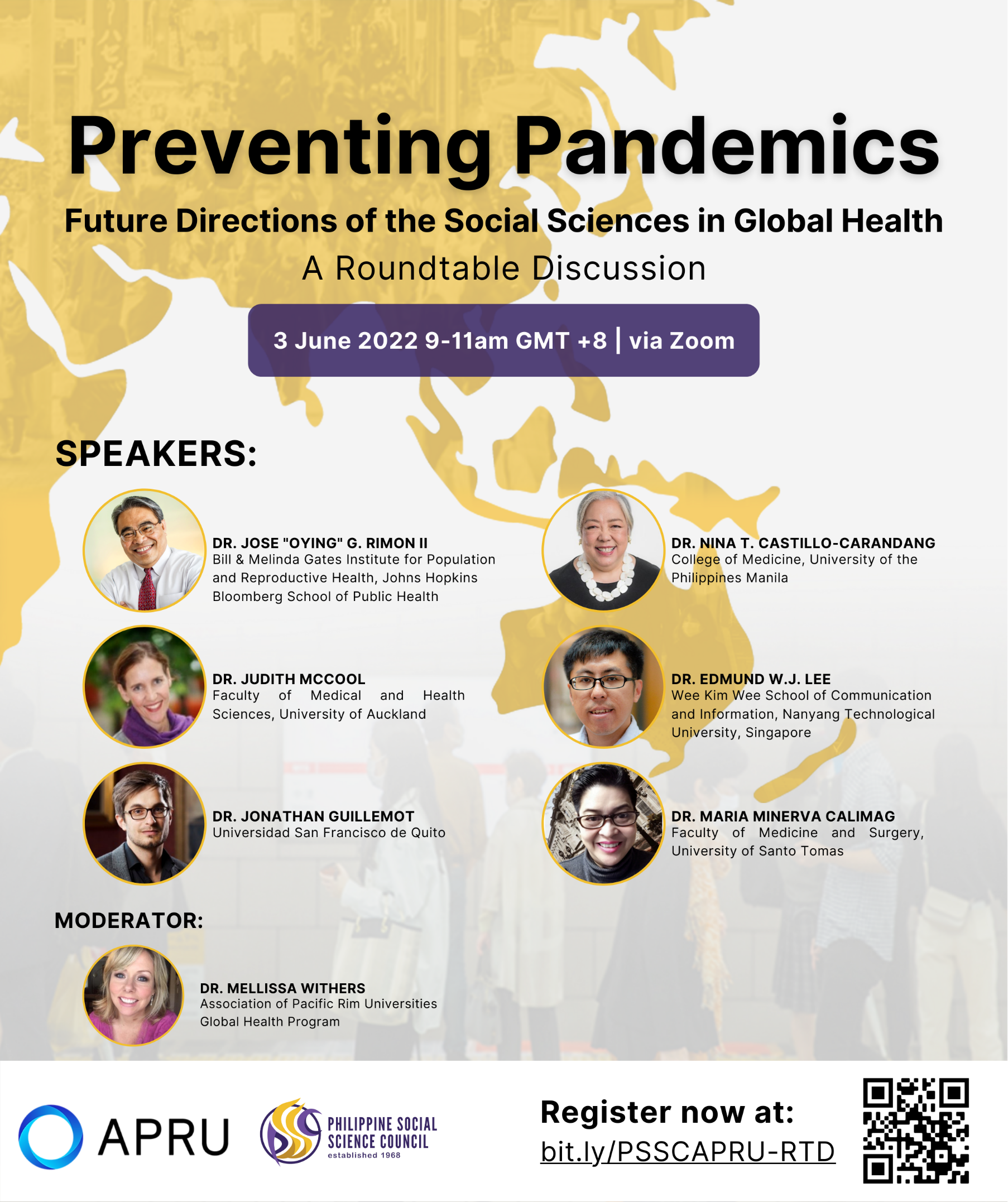
A Roundtable Discussion
3 June 2022 9-11am GMT +8
via Zoom
The COVID-19 pandemic has exposed stark global inequities, fragilities and unsustainable practices that pre-date this pandemic and have intensified its impact. Recovering better from COVID-19 will depend on serious efforts to strengthen health systems, shore up social protections, protect economic opportunities, bolster multilateral collaboration, and enhance social cohesion. Given the scale of action needed, the socio-economic recovery from COVID-19 also provides a historic opportunity to reimagine societies using a social science lens and initiate the transformative changes needed to achieve a better and brighter future.
When it comes to the social science view to prevent and control future pandemics, an understanding of the evolving role of politics, international relations, global health, economics, psychology, sociology, and ethics have all been suggested as meriting urgent consideration by expert researchers. Insights from the full range of social disciplines including global health are needed now more than ever. Faced with pressing challenges and limited resources, governments urgently need robust evidence to inform critical policy decisions. While medical science has been front and center of the response to the virus itself, social scientists have a powerful role to play in our recovery from it. So, what should be the future direction of social sciences to develop programs or solutions that can be adapted and scaled up to prevent future pandemics? How should we prepare for other pandemics, how human behavior can adapt in times of uncertainty, how we understand risk, how we evaluate the cost of different approaches, how we deal with the mental health burden of a pandemic, and how we narrow health gaps, etc.? These are questions for social sciences and global health and PSSC and APRU will try to answer them through a round table discussion.
Speakers:
JOSE "OYING" G. RIMON II
The Bill & Melinda Gates Institute for Population and Reproductive Health, Johns Hopkins Bloomberg School of Public Health
DR. NINA T. CASTILLO-CARANDANG
College of Medicine, University of the Philippines Manila
DR. JUDITH MCCOOL
Facultv of Medical and Health Sciences, University of Auckland
DR. EDMUND W.J. LEE
Wee Kim Wee School of Communication
and Information, Nanyang Technological
University, Singapore
DR. JONATHAN GUILLEMOT
Universidad San Francisco de Quito
DR. MARIA MINERVA CALIMAG
Faculty of Medicine and Surgery, University of Santo Tomas
Moderator:
DR. MELLISSA WITHERS
Association of Pacific Rim Universities
Global Health Program